
Across industries, mobility is undergoing a quiet but profound transformation. From automated warehouses and electric boats to airport ground vehicles and service fleets, machines are becoming cleaner, more autonomous, and increasingly data-driven.
While electrification often takes center stage in discussions about sustainability and efficiency, another evolution is happening beneath the surface: energy systems themselves are becoming intelligent.
Connected battery technologies are reshaping how organizations think about power, performance, and lifecycle management ; and this shift is likely to define the next decade of industrial mobility.
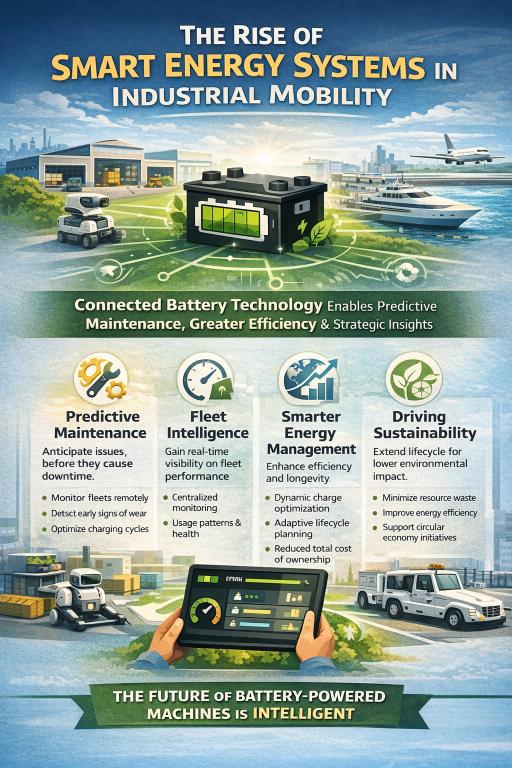
From Power Source to Strategic Asset
Traditionally, batteries were treated as passive components (necessary, but largely invisible). Their role was simple: store energy and release it when needed. Today, that perception is changing.
Modern lithium-based energy systems are designed not only for durability and efficiency, but also for longevity and reduced maintenance. Compared to older technologies, they can dramatically extend equipment lifespan while minimizing downtime and replacement cycles.
According to industry data, advanced lithium systems can significantly reduce total cost of ownership compared to legacy battery formats while lowering environmental impact through longer operational life.
More importantly, batteries are no longer just storage units. They are becoming decision-making tools.
The Emergence of Connected Energy
One of the most transformative developments in energy technology is connectivity.
Through embedded sensors and communication platforms, energy systems can now transmit real-time data on:
- Charge levels
- Temperature
- Usage patterns
- Performance trends
- Health indicators
This data allows operators to monitor fleets remotely and identify potential issues before they escalate into failures. In some advanced applications, connectivity even enables predictive maintenance, allowing teams to intervene before degradation impacts performance.
In sectors where uptime is critical (such as robotics, airport logistics, or maritime transport) this represents a major operational shift.
Instead of reacting to breakdowns, organizations can anticipate them.
Predictive Maintenance: A New Standard
Downtime has always been one of the most expensive hidden costs in industrial operations.
Traditional maintenance models rely on fixed service intervals or reactive interventions. Both approaches carry inefficiencies:
- Over-maintenance wastes time and resources
- Under-maintenance increases failure risk
Connected energy systems introduce a smarter approach.
By continuously monitoring operational data, intelligent batteries can:
- Detect abnormal usage patterns
- Identify early signs of wear
- Optimize charge cycles
- Prevent premature aging
This proactive management helps extend service life and ensures equipment operates at optimal efficiency throughout its lifecycle.
In large fleets, whether autonomous robots or industrial vehicles, this shift can translate into substantial savings and improved reliability.
Fleet Intelligence and Operational Visibility
Beyond individual performance, connected energy systems also provide a broader view of fleet operations.
With centralized monitoring tools, operators can track battery status across multiple machines simultaneously. Some platforms even incorporate geolocation and usage analytics to improve deployment strategies and resource planning.
This level of visibility supports smarter decision-making in areas such as:
- Equipment scheduling
- Utilization balancing
- Charging infrastructure planning
- Lifecycle forecasting
Instead of managing assets blindly, organizations gain actionable insights that help align energy usage with operational needs.
Supporting Electrification Across Sectors
The demand for electrified solutions is expanding rapidly across industries.
For example:
- In maritime environments, electric propulsion reduces noise, emissions, and mechanical maintenance requirements.
- In robotics and automated logistics, fast charging and adaptable energy systems enable continuous operation with minimal interruption.
- In stationary storage applications, modular battery configurations support renewable integration and energy independence strategies.
These use cases highlight a broader trend: electrification is no longer limited to transportation. It is becoming foundational to industrial infrastructure.
However, electrification alone is not enough. Without intelligent energy management, organizations risk replicating inefficiencies in a new form.
This is where connected systems add real value.
Solutions developed by innovators such as Bat Connect illustrate how combining lithium technology with real-time monitoring and adaptive management can transform energy from a constraint into a performance lever.
Sustainability Beyond Emissions
When discussing electrification, attention often focuses on emissions reduction.
Yet sustainability is also about longevity and resource efficiency.
Advanced battery systems designed with eco-conscious principles can:
- Reduce replacement frequency
- Lower lifecycle waste
- Improve energy efficiency
- Support circular economy strategies
Some modern solutions demonstrate measurable reductions in environmental footprint compared to traditional alternatives, thanks to longer lifespans and optimized performance.
In this context, intelligence plays a crucial role. Monitoring usage patterns helps prevent misuse and extend operational life ; ensuring that sustainability gains are not offset by premature degradation.
Toward Autonomous Energy Management
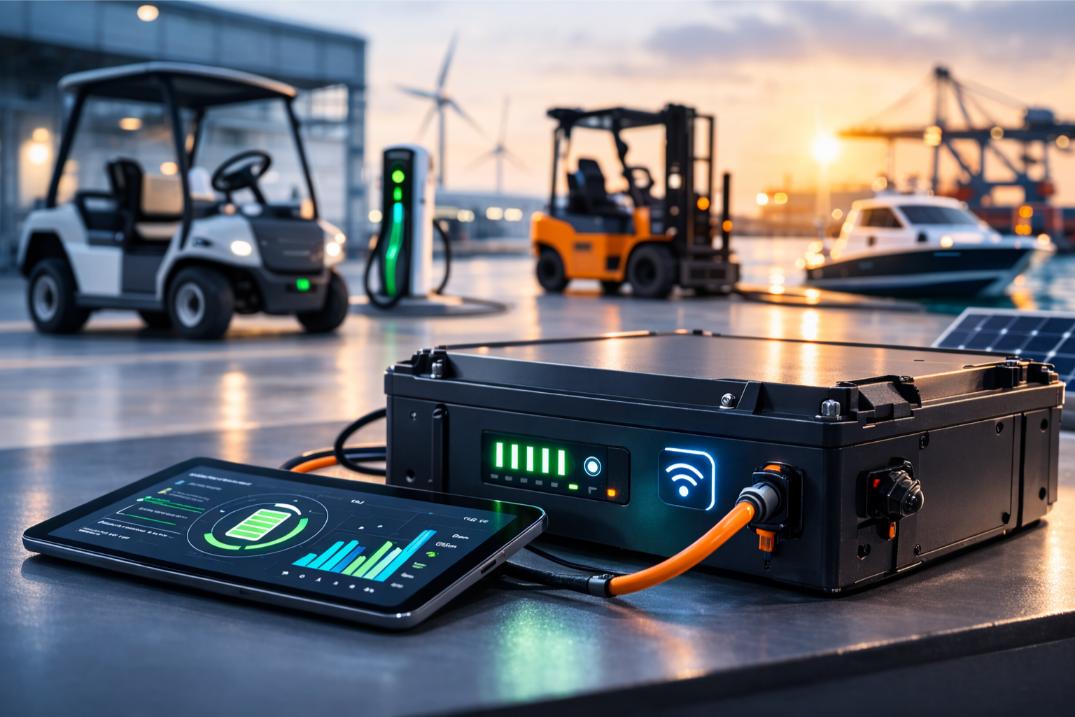
The next frontier in industrial energy lies in autonomy.
As machine learning and analytics capabilities mature, connected battery platforms are evolving from monitoring tools into optimization systems.
Future developments may include:
- Dynamic charge optimization
- Usage-based lifecycle adaptation
- Remote configuration updates
- Automated performance balancing
These capabilities move energy management closer to a self-regulating model — one that adapts in real time to changing operational conditions.
In such an environment, energy systems become active participants in operational efficiency rather than passive suppliers of power.
A Foundational Shift
The transitionto connected energy marks a fundamental shift in how industries approach electrification.
What began as a technological upgrade is becoming a strategic transformation.
By integrating intelligence into energy systems, organizations gain:
- Greater resilience
- Improved efficiency
- Lower long-term costs
- Reduced environmental impact
As electrification accelerates across mobility, robotics, and infrastructure, the real differentiator will not simply be the adoption of batteries, but the adoption of smart, connected ones.
In the coming years, energy will no longer be just something machines consume. It will be something they understand.