
Understanding subperiosteal implants is becoming increasingly important as dental professionals encounter more patients with advanced bone loss and complex rehabilitation needs. Modern dental implant training now includes dedicated subperiosteal courses that help clinicians build the theoretical knowledge, digital planning skills, and hands-on experience required to approach severe bone deficiency cases with confidence.
These programs create a bridge between conventional implantology and advanced treatment planning for patients with limited bone volume. They focus on clinical decision-making, patient-specific implant design, surgical protocols, prosthetic integration, and long-term case management.
For clinicians who want to expand their capabilities in full-arch rehabilitation, subperiosteal implant training offers a structured way to understand a highly specialized area of implant dentistry.
Who should consider subperiosteal implant courses?
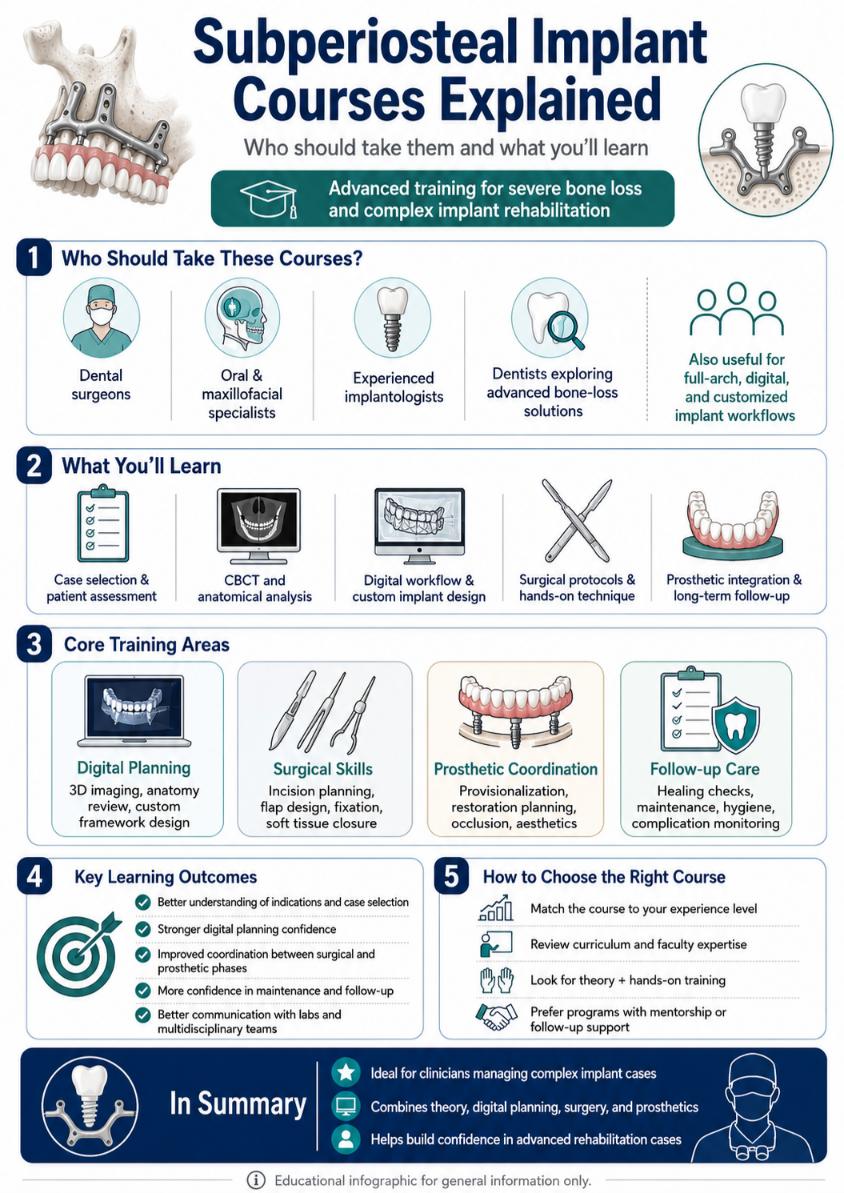
Subperiosteal implant courses are particularly relevant for dental professionals who already manage, or wish to better understand, complex implant cases. Dental surgeons, oral surgeons, maxillofacial specialists, and experienced implantologists may benefit from training that focuses on advanced anatomical situations, especially when patients present with significant maxillary or mandibular bone loss.
These courses are also valuable for practitioners interested in full-arch rehabilitations, digital dentistry, and customized implant solutions. Since subperiosteal implants are designed to fit the patient’s anatomy, the training often brings together surgical thinking, prosthetic planning, and digital workflows in a single treatment concept.
For clinicians looking to move from theory to supervised clinical practice, https://www.subperiosteal.com/ provides a structured pathway covering digital planning, surgical protocols, immediate loading concepts, and prosthetic integration.
Dentists developing their knowledge of advanced bone loss solutions
General dentists who are beginning to explore advanced implantology can benefit from introductory training in subperiosteal implant concepts. These courses help practitioners understand anatomical limitations, case selection, patient evaluation, indications, contraindications, and the role of multidisciplinary planning.
For dentists who refer complex surgical cases, this knowledge can also improve communication with surgical teams, prosthodontists, and laboratories. Understanding the principles behind subperiosteal implants helps clinicians identify suitable cases earlier, explain treatment options more clearly, and participate more effectively in comprehensive rehabilitation planning.
Introductory modules often focus on diagnosis, imaging interpretation, treatment sequencing, and realistic clinical expectations. This makes them useful for dentists who want to broaden their understanding of severe bone deficiency cases while continuing to build their surgical experience progressively.
Experienced implantologists expanding their expertise
For experienced implantologists, subperiosteal courses offer an opportunity to refine advanced techniques and integrate new digital workflows into their clinical practice. Training often includes 3D imaging, virtual planning, CAD-based design, and patient-specific implant frameworks.
These elements are especially useful in cases involving atrophic jaws, where treatment planning requires a precise understanding of bone morphology, soft tissue behavior, prosthetic space, occlusion, and surgical access. By combining digital planning with clinical protocols, experienced practitioners can strengthen their ability to manage complex rehabilitations with greater predictability.
Advanced training may also include model-based exercises, guided surgical simulations, and cadaver workshops. These practical sessions allow clinicians to repeat key steps, receive expert feedback, and develop a clearer understanding of how digital planning translates into surgical execution.
What does one learn during a subperiosteal implant course?
Most subperiosteal implant courses follow a structured curriculum combining theory, planning, and hands-on application. The objective is to help participants understand the complete clinical pathway, from diagnosis to final prosthetic restoration.
The curriculum usually includes patient assessment, radiographic analysis, anatomical review, surgical planning, implant design principles, soft tissue management, prosthetic coordination, and post-operative follow-up. Each module contributes to a more complete understanding of how subperiosteal implants can be planned and delivered in selected clinical situations.
A strong course also develops the clinician’s ability to analyze complex anatomy, communicate with the dental laboratory, and coordinate each stage of treatment with the restorative team.
Digital workflow and custom implant design
Digital planning is one of the central elements of modern subperiosteal implant training. Participants learn how 3D imaging and digital reconstruction can be used to study the patient’s anatomy and prepare a customized framework.
This part of the course usually focuses on interpreting CBCT data, identifying anatomical landmarks, evaluating bone support, and understanding how prosthetic objectives influence implant design. The goal is to connect the surgical plan with the final restoration from the earliest stages of treatment.
Participants also learn the importance of collaboration between the surgeon, restorative dentist, and dental technician. This interdisciplinary approach helps align implant positioning, prosthetic emergence, occlusal balance, and aesthetic objectives.
Hands-on surgical technique and operative protocols
The hands-on component is a key part of subperiosteal implant training. Under expert supervision, participants can study incision planning, flap design, exposure of the bone surface, framework adaptation, fixation principles, and soft tissue closure.
Practical sessions may use anatomical models, high-fidelity simulators, or cadaver-based workshops depending on the level and format of the course. These exercises allow participants to better understand the sequence of the procedure and the clinical details that influence treatment outcomes.
A structured hands-on environment also helps practitioners become more familiar with intraoperative decision-making. Variations in bone morphology, tissue thickness, surgical visibility, and prosthetic requirements are all important aspects of real clinical practice.
Prosthetic integration and restoration planning
Successful subperiosteal implant treatment depends not only on surgical placement but also on careful prosthetic integration. For this reason, many courses include dedicated modules on provisionalization, definitive restoration, occlusion, aesthetics, and maintenance.
Participants learn how the prosthetic plan influences implant design and surgical execution. They also study how to coordinate the transition from surgery to restoration, with attention to function, comfort, hygiene access, and long-term stability.
This part of the training is essential because subperiosteal implants are often used in complex full-arch rehabilitation cases. A well-planned prosthetic workflow supports a smoother clinical process and helps the entire treatment team work toward the same functional and aesthetic objectives.
Follow-up care and complication management
Post-operative care is another important part of subperiosteal implant education. Courses typically cover healing follow-up, hygiene instructions, prosthetic maintenance, soft tissue monitoring, and early identification of potential complications.
Participants learn how to structure follow-up visits, communicate clearly with patients, and coordinate with the restorative and laboratory teams after surgery. This helps support stable outcomes and reinforces the importance of long-term maintenance.
Rather than focusing only on the surgical act, high-quality training emphasizes the complete patient journey. This includes diagnosis, planning, surgery, restoration, follow-up, and continuous evaluation.
Professional development and clinical value
Subperiosteal implant courses can have a meaningful impact on professional development. As demand grows for advanced solutions in patients with severe bone loss, clinicians with training in this area can broaden their treatment planning perspective and strengthen their role in complex rehabilitation cases.
These courses also encourage critical thinking, ethical decision-making, and interdisciplinary collaboration. Participants gain more than technical knowledge; they develop a deeper understanding of how to assess indications, plan safely, and coordinate advanced care.
Key learning outcomes may include:
- A stronger understanding of subperiosteal implant indications and case selection
- Familiarity with digital planning tools and customized implant design
- Knowledge of surgical protocols for advanced bone deficiency cases
- Improved coordination between surgical and prosthetic phases
- Greater confidence in follow-up care and maintenance planning
- Better communication with laboratories and multidisciplinary teams
Choosing the right subperiosteal implant course
Choosing the right course depends on the clinician’s background, current experience level, and professional objectives. Some programs are designed as introductions to the principles of subperiosteal implants, while others focus on advanced surgical application and hands-on training.
Before selecting a course, practitioners should review the curriculum, faculty experience, training format, clinical focus, and opportunities for mentorship. Programs that combine theoretical education, digital planning, practical exercises, and follow-up support often provide the most complete learning experience.
For dental professionals interested in advanced implant rehabilitation, subperiosteal implant courses offer a valuable opportunity to expand clinical knowledge, improve treatment planning, and develop skills that can support complex patient care.